Start with the person, not the occasion
The most common mistake in retirement cards is writing about retirement in general, not the specific person in front of you. "Happy retirement, you've earned it!" is technically correct but tells the reader nothing about themselves. A card that names something true about them is worth ten times that.
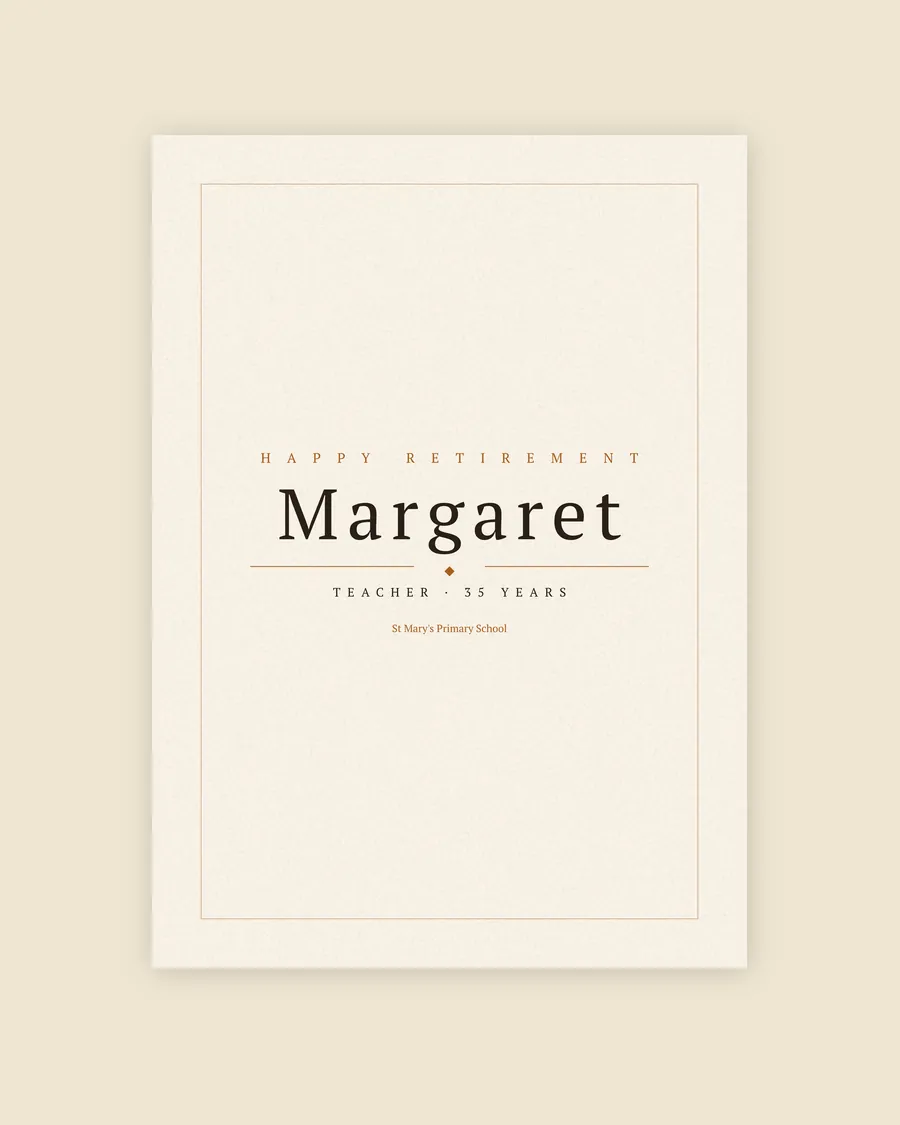 The Personalised Name Print From £15.99
Poster
Their name, their profession, their years of service and where they worked, set in type beneath a Happy Retirement line.
See all sizes and pricesEven one specific sentence transforms a card. "The office won't be the same without your ability to stay calm in the situations that broke the rest of us" is memorable in a way that "wishing you a wonderful retirement" is not.
What to include, a simple structure
You don't need to fill the card. Three elements are enough:
- Something specific about them. A quality they brought to work, a memory, a contribution you actually noticed.
- Acknowledgement of the occasion. Not just "congratulations": something that marks the scale of the milestone, whether that's 5 years or 40.
- A look forward. What you hope for them in the next chapter, not what you assume they'll do, but a genuine wish.
For close colleagues or family, add a personal note on a separate piece of paper if the card is running out of space. A card isn't the place for an essay, but the gesture of writing more shows the occasion mattered.
Retirement card messages by relationship
From a colleague
"[Name], it's been a privilege to work alongside you. You made the hard days easier and the good ones better. Whatever comes next, I hope it rewards you as much as you've put in."
"Working with you taught me more than I can list in a card. Thank you for that, genuinely. Enjoy every slow morning: you've earned all of them."
"The department loses a serious amount of expertise and good sense when you leave. That's a compliment, not a complaint. We'll miss you, and hope you'll miss us a little."
From a manager
"You have been one of the most reliable people I've had the privilege to manage:and by reliable I mean in all the ways that actually count, calm under pressure, generous with your knowledge, and straight with us when it mattered. Thank you for everything you've given to this team."
"Leading this organisation has been easier because of the people it's made of. You're one of those people. Thank you for [X] years, and for everything that won't appear in a handover document."
From a direct report
"You were the kind of manager that teaches by example. I came into this role as one version of myself and leave it as a better one, that's largely down to you. Thank you."
"I've learned things working with you that I'll carry into every job that follows. That's the kind of mark that doesn't appear in a performance review but matters more."
What to write in a retirement card for a friend
"Forty years, and you still talk about the job like you're glad you did it. Cheers to doing whatever you like with the next forty."
"No more Sunday-night dread. I'm proud of you, and I'm claiming the first weekday lunch."
From family: spouse or partner

"[X] years of early mornings, late returns, and everything in between, and you never once made any of us feel it was a burden. Now it's your turn. We're excited to see what you do with it."
"You've given so much to work for so long. Watching you build that career has been one of the things I'm proudest of. Now I get you back, and I couldn't be more glad of it."
From family: children or grandchildren
"We've always known how hard you worked, even when we were too young to understand what it meant. Thank you for everything that work made possible. We love you."
"Growing up watching you go out every morning taught us more about dedication than we realised at the time. This is a well-deserved new chapter: enjoy every moment."
Short retirement wishes for someone you don't know well
For cards that are circulating around an office and reaching colleagues who only interacted occasionally, keep it warm but general:
"Congratulations on [X] years, a genuine achievement. Wishing you the best of what comes next."
"Thank you for your contribution to this team. It didn't go unnoticed. Enjoy the next chapter."
Short is fine. The card will be signed by many people; yours doesn't need to be the longest. What matters is that it says something, not nothing.
Happy retirement messages, and what to say instead
"Happy retirement" is the line every other signature on the card will already carry. It is not wrong, but it says nothing only you could say. Keep it if you like and add one line after it, or replace it with something that names the person or the place:
"Congratulations on thirty-two years at the depot. Nobody knew the rota like you."
"The ward will carry on, but not in quite the same way. Thank you for all of it."
"Here's to the next thing, whatever you decide it is."
"Enjoy the first Monday morning with nowhere to be."
Any of these can follow a line of your own about the person, or stand in for one when the card has already gone round twice.
What to avoid
Don't mention age. Even obliquely. "You don't look old enough to retire" is intended kindly but lands oddly. The focus should be on what they've built, not on where they are in life.
Don't use loss framing. "We're so sad to see you go" makes it about the writers, not the recipient. The card is for them. "We'll miss you" is fine; "we're devastated" is not.
Don't write anything you'd feel odd saying aloud. Cards get read at home, quietly, more than once. If you wouldn't say it in person, don't write it.
Don't end with "enjoy your retirement" and nothing else. It's the card equivalent of fading out. Find one specific word for what you hope for them.
Adding a quote
A well-chosen quote can carry a card when you're not sure what to say in your own words. Choose one that fits the register: wry for someone who wants a laugh, sincere for a more formal occasion. For a full selection, see the retirement quotes guide.
When the card comes with a gift

If the card accompanies a personalised print or a piece of framed art, mention it briefly inside. "We hope this finds the right wall" is enough, you don't need to describe the gift. Let the gift speak for itself.
For personalised options that pair well with a card, the personalised retirement gifts collection is a good starting point, or go straight to the name print page to build something specific to them.
One final thought
The person retiring will read the card more than once. They'll read it on the day, probably again that evening, and possibly years later when they find it in a drawer. Write something that holds up to that. Specific is kind. Vague is forgettable. The occasion is big enough to warrant a few sentences that mean something.

Related pages: retirement gifts · retirement gifts for women · for dad · for a colleague · personalised retirement gifts